This morning we covered the book of Ruth in our class on Joshua, Judges and Ruth. The class has now ended, but since we did not have time to cover all of the book of Judges I will be making some additional posts in the near future. I am sure that you will want to see some pictures to illustrate Samson and Gideon.
According to Josephus, the account of Ruth happened in the days of Eli. In Ruth we find that Elimelech and Naomi, along with their sons Mahlon and Chilion leave Bethlehem to go to Moab because of a famine that is in the land. While Naomi is sojourning in Moab for ten years, her husband dies and the two sons marry Moabite women. Naomi’s two sons also die and she is left alone with her two daughter-in-laws. I am sure that we all know the story about how she hears about how food is now available in Bethlehem and wants to return. As she is returning she offers to release Ruth and Orpah from their responsibility to her and let them return to their own people. Orpah returns to Moab, but Ruth continues on to Bethlehem with Naomi. The verse below is probably the most referenced passage from the book of Ruth.
But Ruth said, “Do not urge me to leave you or to return from following you. For where you go I will go, and where you lodge I will lodge. Your people shall be my people, and your God my God. Where you die I will die, and there will I be buried. May the Lord do so to me and more also if anything but death parts me from you.” (Ruth 1:16-17, ESV)
Once Naomi and Ruth return to Bethlehem, Ruth helps in the barley and wheat harvests.

In the picture above we see a field that has been harvested. This is not barley or wheat as this picture was taken in September of last year when we were driving through the Shephelah, in an area not far from Bethlehem. This is possibly flax or some other summer crop and barley and wheat are spring crops. As the story progresses we learn about the different requirements that the land owners had in leaving part of the crop so that those who were poor would be able to glean from the remains. We also get a good glimpse into the social structure of Bethlehem. We see the relationship between Boaz the landowner, his servants and also the others who are gleaning in the fields.
At the end of the harvest we reach the climax of the story. Here Ruth lays down at the feet of Boaz while he is sleeping and in essence offers herself to him so that he may be her redeemer.
Then she came softly and uncovered his feet and lay down. 8At midnight the man was startled and turned over, and behold, a woman lay at his feet! He said, “Who are you?” And she answered, “I am Ruth, your servant. Spread your wings over your servant, for you are a redeemer.” And he said, “May you be blessed by the Lord, my daughter. You have made this last kindness greater than the first in that you have not gone after young men, whether poor or rich. And now, my daughter, do not fear. I will do for you all that you ask, for all my fellow townsmen know that you are a worthy woman. And now it is true that I am a redeemer. Yet there is a redeemer nearer than I. Remain tonight, and in the morning, if he will redeem you, good; let him do it. But if he is not willing to redeem you, then, as the Lord lives, I will redeem you. Lie down until the morning.” (Ruth 3:8b-13, ESV)
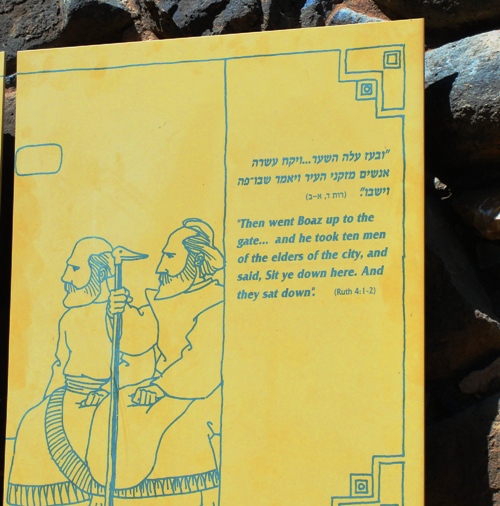
In chapter 4 of Ruth we find out how Boaz went to the city gate to seek out the redeemer who was closer than him. We witness an interesting transaction where Boaz obtains both the property of Elimelech and also the right to marry Ruth. According to the law the transaction is sealed with the removal of a sandal.
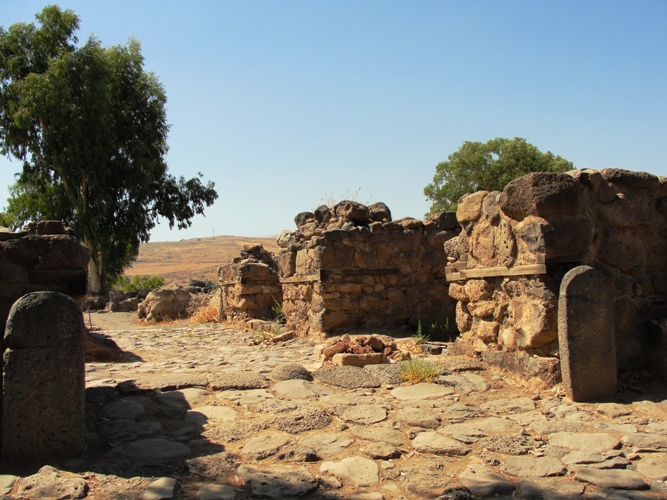
The picture here is not from the gate at Bethlehem, as ruins of it have not been discovered. This gate is at Bethsaida. It shows a typical multi-chamber gate where people would meet and business matters would be taken care of. To me this reminds me of how a small town post office used to function. I have a memory coming back to me of the older men who would meet up each morning outside of our small town post office and discuss the town happenings. If you wanted to know what was going on you only had to go have a visit with them :-).
OK, back to the account. Ruth and Boaz marry and have a son named Obed, which means servant. Obed was the father of Jesse and the grand-father of King David.
I like what Josephus writes at the end of his account of Ruth.
I was therefore obliged to relate this history of Ruth, because I had a mind to demonstrate the power of God, who, without difficulty, can raise those that are of ordinary parentage to dignity and splendor, to which he advanced David, though he were born of such mean parents.
I have always liked the book of Ruth as it gives us a glimpse of people who are following the law of the Lord in a time when many people are not following it at all. We also see how they are rewarded for their service to God.
Steven
If you would like to catch up with the class, here are the previous posts:
To view links to the entire class series click on Walls of Jericho.
 Braman's Wanderings
Ruth is one of my favorite books in the Bible. Thanks!!
Great to see some interesting insights on this!
Pingback: et-Tell | Braman's Wanderings
Pingback: Wednesday Wanderings | Braman's Wanderings
Pingback: A Beautiful Sunday | Braman's Wanderings