
Here in the US we have only one train system that is considered High Speed Rail. The Acela Express runs on the Northeast Corridor between Boston and Washington, D.C. By international standards the train is comparatively slow as the top speed is only 240 km/h and the average speed over the entire route is only about 100 km/h. For those of you who are metric system challenged that is about 150 mph and 65 mph. Still this route is the most successful in the Amtrak system and has a large market share of the travelers between the cities that it serves.
My fascination with high speed trains began back in the very early 90’s when I took my first international trip. I had to go to Lyon, France for a training class. I flew into Paris and then took the train to Lyon.
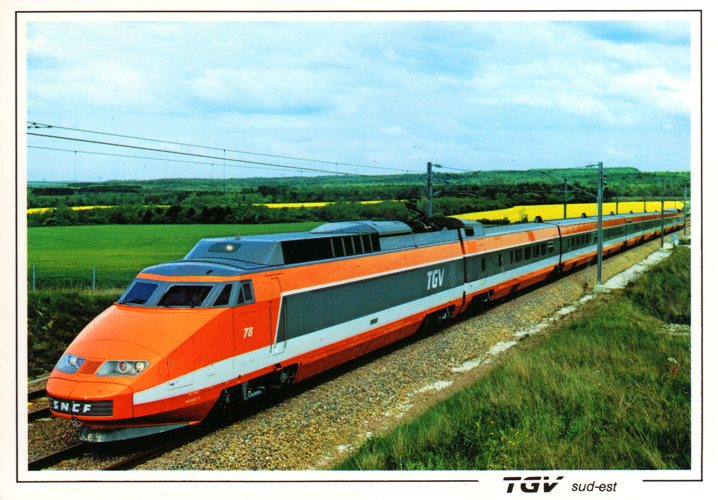 The train that I took was at that time the fastest in the world. In test trials the train had set a record of 380 km/h (236 mph) in 1981, but only operated at about 270 km/h (168 mph). The picture above is a scan of the postcard that I bought at the train station, and the source of my numbers here. The train in the picture is the Train à Grande Vitesse (TGV). As I write this I am having memories of that trip and wondering at the speed of the train. My only comparison was riding Amtrak to California to visit my grandparents when I was a kid.
Now, fast forward about 25 years.

During a trip to Shanghai about seven years ago I took the Shanghai Maglev Train to the airport. The train line is less than 20 miles long, but at the fastest point in the trip you get up to 431 km/h (268 mph). I have a very blurry picture of the display at 431 km/h, but thought I would share this one instead. You can see that other passengers were also taking pictures of the display.
Since that time China has been developing a network of High Speed Rail. The network that they are rapidly developing is conventional rail, but it is still very fast.
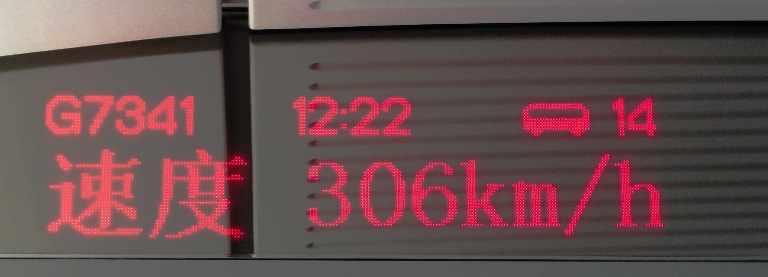
Here is a picture of the top speed that we reached on a trip from Shanghai to Hangzhou earlier this month. The train is capable of much higher speeds (>400 km/h), but the government limits the speed for safety and energy conservation (cost). It was still amazing to be smoothly traveling at 306 km/h (190 mph) and watching the countryside fly by.
I have also taken high speed trains in Japan (Shinkansen), Germany (ICE) and the Netherlands (ICE). High Speed Rail is a very efficient way to travel in Europe and other countries around the world.
Here in California they are supposed to start the construction of a High Speed Rail line later this summer. However, it will be many years before anyone will be traveling at high speeds on rail here in California.
What is the fastest train you have ridden on?
Steven
 Braman's Wanderings
It’s fun to read how you enjoy riding the high speed trains in different cities. I find that when using rapid transit systems in unfamiliar cities that I get so stressed trying to figure out the schedules and fare systems that by the time I get on the train I don’t enjoy it.
Probably the TGV trains in France, Steven. Wonderful ride.
Haven’t ridden a train for years. This train is beautiful …
431 km/h is insane! HA, our train might go 40 km/h top speed, it’s actually Light Rail Transit and crosses the city NE to SE via downtown and the university. It’s really handy during events, as our current Arena and Stadium are direct stops. When I was younger and single, I had an apartment not to far from one stop and road it to work every day. Awesome because I always had lots of reading for work and got much of it done in transit. Edmonton is currently expanding the LRT from East to West and to another major Campus. So hopefully a lot of drivers will leave their cars at home and use it.
Pingback: Tank Town | Braman's Wanderings
Pingback: High Speed Rail Memories | Braman's Wanderings