
Time for our weekly lesson from the Joshua class I am attending on Sunday morning. Last week I missed the class as I was out of town, but still managed to post about most of what was covered in The Gibeonite Deception.
This week we covered a lot of text as we explored the conquest and division of the land of Canaan by Joshua and his army. I thought about the best way to lay this out in a post, and couldn’t really come up with too much, so I am going to wing it and just start typing :-).
Joshua first had to put down an attack on Gibeon put together by a group of Amorite kings from the southern Canaanite cities. The kings of Jerusalem, Hebron, Jarmuth, Lachish and Eglon put together an army to attack Gibeon. Of course the Gibeonites sent for help from the Israelites and battle ensued. Large hailstones and an extended day as the sun stood still helped Joshua defeat the Amorites and also capture the five kings who had holed up in a cave at Makkedah. The five kings were put to death and hung from five trees until sunset at which time they were thrown back into the cave.

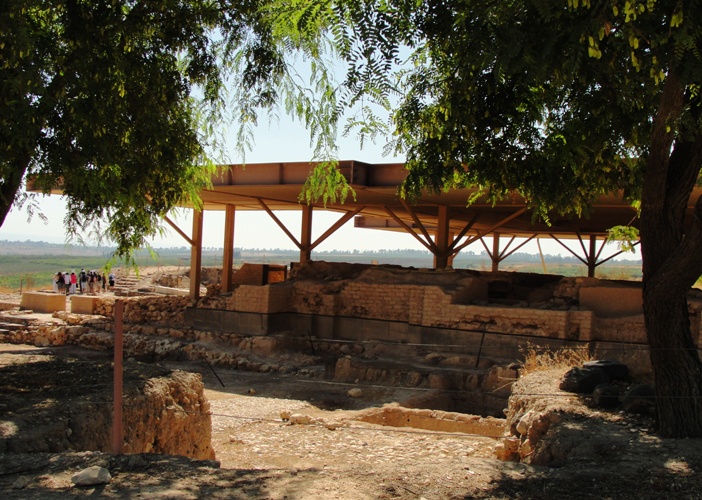
The Israelites then proceeded to capture the cities of southern Canaan, including Lachish which is shown in the picture above. Lachish is one of the cities that we visited in the Shephelah, on the last day of my vacation to Israel earlier this year.
We did not visit Hebron, but Caleb was later given this city when the land was being divided.
After the conquest in the south, King Jabin of Hazor heard of it and put together a coalition of northern kings. They met in battle with Joshua and Hazor was taken and King Jabin was put to death.
In the picture above are the remains of the palace where the Canaanite kings of Hazor lived. Among the ruins is evidence of the fire from when Joshua burnt the city. Signs at the site of Hazor say that it is the largest Tel in Israel. The city had both an upper and lower level and was the largest city in Canaan at the time of the conquest.
With a large portion of Canaan captured, Joshua, Eleazer the priest and the heads of the tribes met to divide the land. The land was divided by lot. I will not go into the details of which tribe was given what portion and how big or how little they were in this post. However, several interesting accounts in Joshua caught my eye.
And Caleb said, “Whoever strikes Kiriath-sepher and captures it, to him will I give Achsah my daughter as wife.” And Othniel the son of Kenaz, the brother of Caleb, captured it. And he gave him Achsah his daughter as wife. (Joshua 15: 16-17 ESV)
We will see Othniel again when the class moves on to the book of Judges.
Now Zelophehad the son of Hepher, son of Gilead, son of Machir, son of Manasseh, had no sons, but only daughters, and these are the names of his daughters: Mahlah, Noah, Hoglah, Milcah, and Tirzah. They approached Eleazar the priest and Joshua the son of Nun and the leaders and said, “The Lord commanded Moses to give us an inheritance along with our brothers.” So according to the mouth of the Lord he gave them an inheritance among the brothers of their father. Thus there fell to Manasseh ten portions, besides the land of Gilead and Bashan, which is on the other side of the Jordan, because the daughters of Manasseh received an inheritance along with his sons. The land of Gilead was allotted to the rest of the people of Manasseh. (Joshua 17:3-6 ESV)
This account of the daughters of Zelophehad appears in several places in the Old Testament and whenever I read it I think of asking someone how many sisters Noah had. However, what I really like about this is that we find that women also had inheritance rights that were respected.
Just a few verses later the tribe of Ephraim is complaining about how much land they received.
The people of Joseph said, “The hill country is not enough for us. Yet all the Canaanites who dwell in the plain have chariots of iron, both those in Beth-shean and its villages and those in the Valley of Jezreel.” Then Joshua said to the house of Joseph, to Ephraim and Manasseh, “You are a numerous people and have great power. You shall not have one allotment only, but the hill country shall be yours, for though it is a forest, you shall clear it and possess it to its farthest borders. For you shall drive out the Canaanites, though they have chariots of iron, and though they are strong.” (Joshua 17:16-18 ESV)

This picture shows some of the ruins from Beth-shean from the Canaanite period.

Tel Bet She’an towers over the later Byzantine city of Scythopolis. From the top of the tel you get a great look at the ruins of Scythopolis. Beth-shean was in a very strategic location along the trade routes so was rebuilt over and over again.
I hope you enjoyed this whirlwind look at the conquest and division of Canaan.
Steven
If you want to catch up with the class, here are the previous posts:
To view links to the entire class series click on Walls of Jericho.
 Braman's Wanderings
Absolutely fascinating dialogue and great pictures!!! Alwaye felt sorry for Hoglah. Wonder what her name means?
Pingback: Archaeology Quote | Braman's Wanderings
Pingback: Images for Sunday III | Braman's Wanderings
Pingback: Walking with Joshua | Braman's Wanderings