A Visit to a German Cemetery

In genealogy research I have often visited cemeteries. Sometimes cemeteries are in rural settings, and sometimes in cities. You sometimes find interesting monuments, or find graves of important people.

Jena germany, cemetery, famous gravesWhen I travel I will also sometime visit cemeteries like the Johannisfriedhof in Jena, Germany. This is a very interesting cemetery with the graves of quite a few famous people, however, they may not be well known outside of Germany or academia.
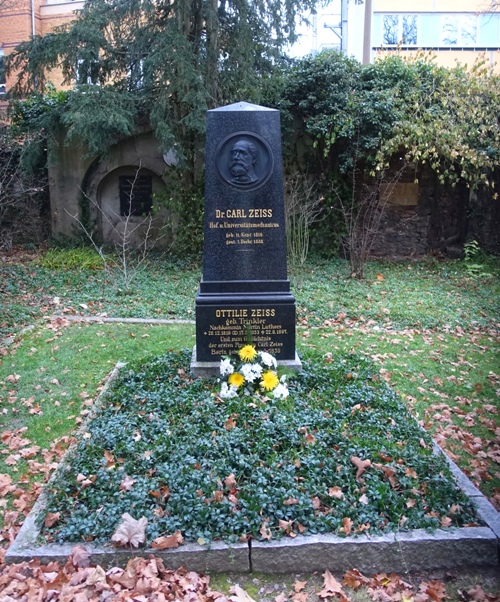
Carl Zeiss, gravestone, Jena, GermanyThere is one particular grave that I visit in the cemetery. It is the grave of Dr. Carl Zeiss who was the founder of the company I work for. The Zeiss name is known around the world for optics.

Church of St. Johannes Baptist, Jena, Germany

The cemetery surrounds a baroque style church consecrated in 1693. The original name of the church was the Johann Georg Church. The church was named for John-George II the Duke of Saxe-Eisenach.

The cemetery itself is much older with the earliest documented reference of 1307.
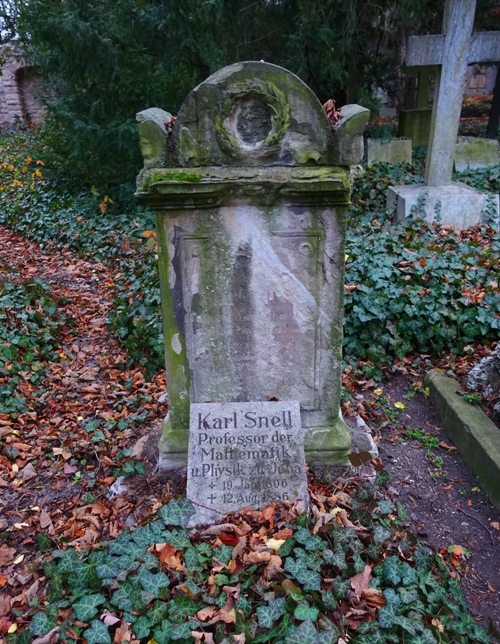
Karl Snell, Ernst Abbe, Jena, Germany

There are many professors from the Jena University buried in the cemetery including Karl Snell who was the father-in-law of Ernst Abbe.

Ernst Abbe was a partner of Carl Zeiss and helped build the company.
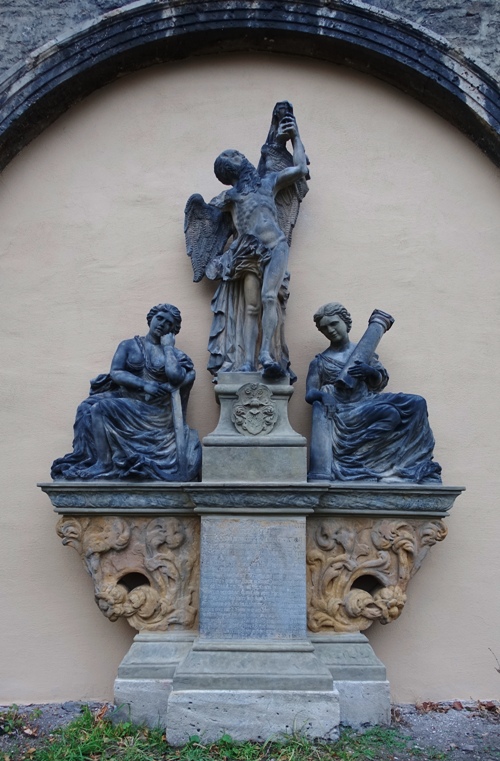
Jena Germany, cemetery

This monument is on the side of the church building and is for the Kreußler family.

Members of the Kreußler family were fencing masters at the Jena University in the 1600’s.

Jena, Germany, Schopenhauer Grave

Another grave that I visited was of Johanna Schopenhauer who was the first German woman to publish books without using a pseudonym. She died in Jena in 1838.

Her son Arthur Schopenhauer was a well known philosopher who influenced Nietzsche, Jung, Mann, Schrodinger and Einstein.

You can learn a lot about History while visiting a cemetery.

Steven

Posted in Culture, Education, Genealogy, Germany, History, Travel | Tagged , , , , | Leave a comment

A Big Head

On Saturday I made a trip to Chemnitz to visit a museum. I asked colleagues at work if there was anything else I should see while I was there. They all told me that I should see the Nischel.

Nischel, Karl Marx, Chemnitz, Socialism, Big Bust, Head

Nischel is a nickname derived from a German word meaning head or skull.

Here you can see my first view of the Nischel.

Nischel, Karl Marx, Chemnitz, Socialism, Big Bust, Head

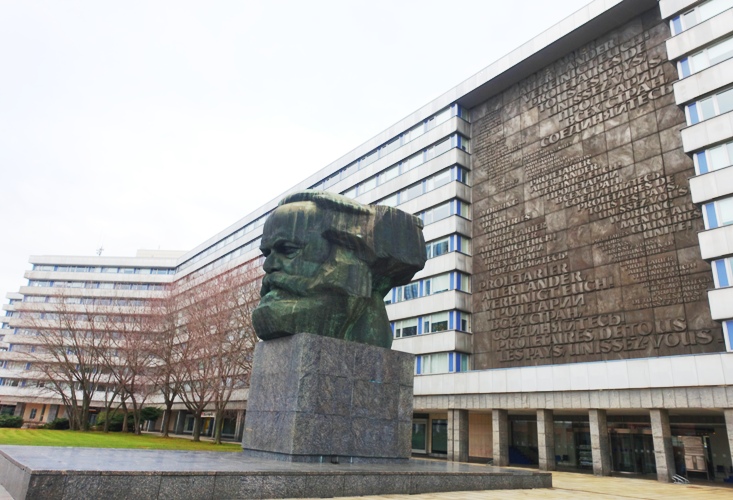
Here is a closer view of the big head and you should be able to tell that it is the head of Karl Marx.

I was wondering why there was a monument to Karl Marx in Chemnitz, as I knew that he was from Trier which is in the west part of Germany.

I found out that Chemnitz was renamed in 1953 to Karl-Marx-Stadt due to the large amount of industry there.

The people who live here do not look back, but look forward to a new and better future. They look at socialism. They look with love and devotion to the founder of the socialist doctrine, the greatest son of the German people, to Karl Marx. I hereby fulfill the government’s decision. I carry out the solemn act of renaming the city and declare: From now on, this city bears the proud and mandatory name Karl-Marx-Stadt.

GDR Prime Minister Otto Grotewohl

Nischel, Karl Marx, Chemnitz, Socialism, Big Bust, Head

On the wall behind the big head is a plaque with the phrase ‘Working Men of All Countries Unite!’ in four languages.

Nischel, Karl Marx, Chemnitz, Socialism, Big Bust, Head

The Karl Marx monument was created by Lev Kerbel a Soviet sculptor. The monument was dedicated in 1971. The head is a bit taller than 23 feet and with the pedestal has an overall height of about 42 feet.  Overall the monument weighs over 40 tons. Definitely a big head.

Nischel, Karl Marx, Chemnitz, Socialism, Big Bust, Head

As I was heading back toward the train station I walked by the monument again. The setting sun bathed the building in light and it made for an interesting picture. You can definitely see how large the head is.

In 1990 the city was renamed back to Chemnitz. There have been discussions as to the fate of the Karl Marx monument, but for now it remains as a reminder of the cultural history of the city.

Steven

Posted in Culture, Germany, History, Travel | Tagged , , , , , | Leave a comment