The next destination on my Virtual Hike was Stepstone Creek, Kentucky.
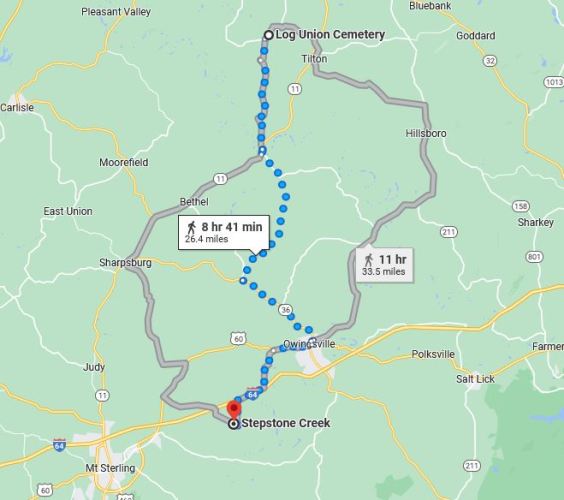 The previous destination on my virtual hike was Log Union Cemetery, Kentucky.
You can see in the map above that it is only 26.4 miles to Stepstone Creek.
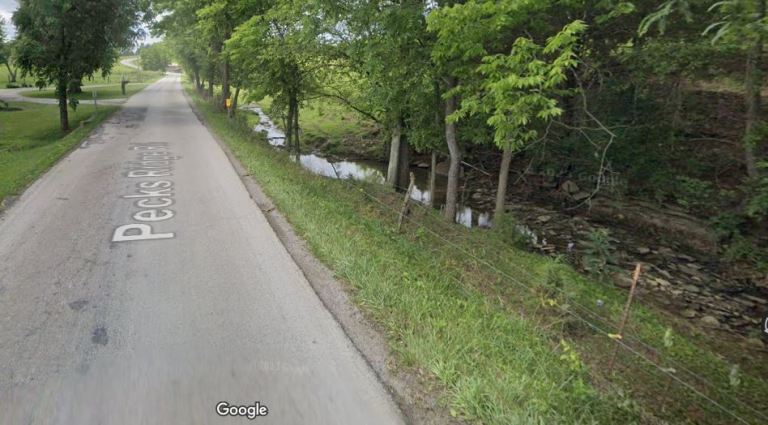 The virtual route was through rural areas and often it crossed small creeks or followed them.
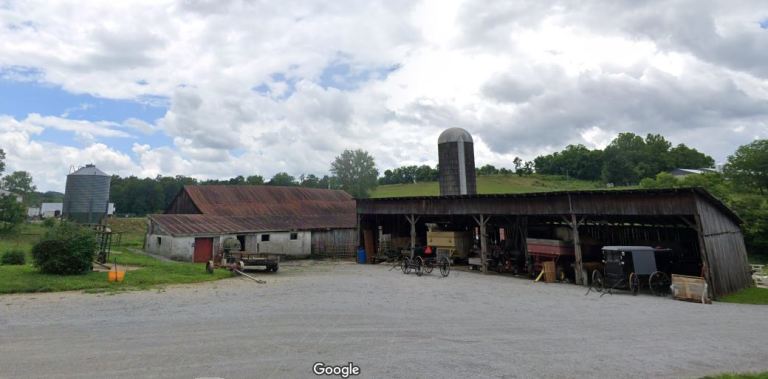 It also passed many farms, including this Amish farm. It is interesting that today there are many Amish and other plain settlements in the area. Back in the late 1700’s a large group of German settlers came to Kentucky from North Carolina and settled in this area.
 There was one small town that the route went through, but mostly the route was lined with fields or trees.
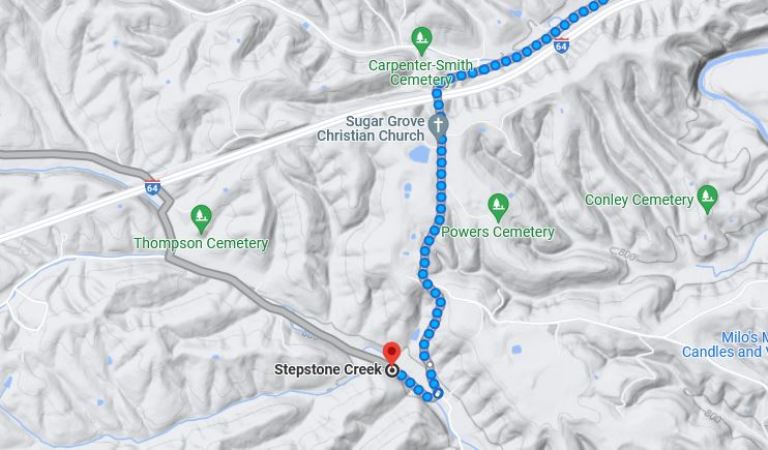
The virtual hike finally made it to Stepstone Creek. There were no Google Street View images for the area, so Instead I added a topographic map here.
Stepstone Creek is where in 1821 Peter Hon organized a congregation of Christians. This would not have been a Dunkard church as He has been dismissed from the Dunkards in the mid 1810’s. At this time Peter Hon had a young family and was most likely looking for a home base for his work as a mister or evangelist. He would not have been able to take over for his father at East Union or Log Union as they were still in the Dunkard fold. Peter Hon maintained a farm near Stepstone Creek till his death in 1876.
There is a good history of Peter Hon and the organization of the Stepstone Creek church at The History of the Restoration Movement website. I want to address a couple questions that are brought up in the article.
Even though the exact nature of the congregation located on the waters of Stepstone cannot be ascertained, at this point it is believed that three sound inferences are in order. First, by the process of elimination, and in consideration of evidence that Hon had been influenced by Stone, the logical assumption is that he established on Stepstone Creek in Montgomery County a congregation similar to those of the Stone persuasion. If that assumption be not sound, one must then assume that former Dunkards Hon and Hostetler were responsible for a Restoration initiative independent of those of both Stone and Campbell.
This statement to me brings up some good points, but also some additional questions. I believe that Stone was influenced as much by the Dunkards as he influenced them. There is also much evidence that they were both working on Restoration in parallel at this time. The Dunkards mainly in the German speaking churches and Stone in the English speaking churches.
In researching family history I started to see connections between the two groups in the early 1800’s. Peter Hon performed many marriages in the area and you can start to see the families of the Stone and Hon groups start to inter-marry.
Secondly, the discovery of the above mentioned document somewhat alters the generally accepted view that the Restoration initiative in Montgomery County was the exclusive result of John Smith’s efforts as he was influenced by Alexander Campbell. Had the deed for the property on the waters of Stepstone Creek not revealed the date of the work of Hon, his contribution most likely would have remained in oblivion, inundated by the phenomenal success of Smith in bringing the masses into the camp of the Reformers.
I believe that this is partially due to the fact that Hon was most likely still working with German speaking congregations. There was probably not as much awareness to what was going on with Hon’s work. When the initial histories of the Restoration Movement were compiled in the early 1900’s the German influence was also probably overlooked because of World War I and II.
Thirdly, it is very possible that Peter Hon’s presence in Montgomery County exerted a “softening” influence upon John Smith which assisted in conditioning him for his significant role in the union of the Stone end Campbell forces in 1832. There is no doubt about the existence of the “Line of Demarcation” between Stone’s Bourbon and Smith’s Montgomery Counties.
I agree with this, but believe that the bigger influence was with the Hoosier Brethren and Blue River Baptist Association of John Wright in Indiana which merged together and then merged with the Newlights.
I will write later about a family connection with Peter Hon and the many ministers in some of the connected families. You can see a bit of this in my post from the last destination.
Now that I am virtually in Kentucky I have made my way to where some of my ancestors and families lived in the early 1800’s and also where a significant religious event took place. I will spend some time in this area visiting a few other places and building on the history shared in this post.
Most of the next stops will have family connections as well as connections to early Restoration Movement History.
I am still working on the route past this area as I learn a lot more about how migration routes changed as the frontier pressed further west.
Steven
Images in this post are from Google Maps and Street View
WwRI – Written With Real Intelligence
 Braman's Wanderings
Stepstone Creek
cjsmissionaryministry@gmail.com
Pingback: Virtual Hike to East Union, Kentucky | Braman's Wanderings