For the last few days I have been on the lookout for the latest issue of Biblical Archaeology Review (BAR). Each day I have been disappointed when I checked my mailbox, but tonight it was there.
It has become a tradition now to write a post about what I find interesting In the BAR. I am now on post number six.
Here are the links to the previous posts:
The cover picture is a 7th Century golden medallion that was found in Jerusalem. The medallion has a menorah and other Jewish symbols on it and is the lead photo for an article on Jews in Christian Jerusalem that was edited by Hershel Shanks.
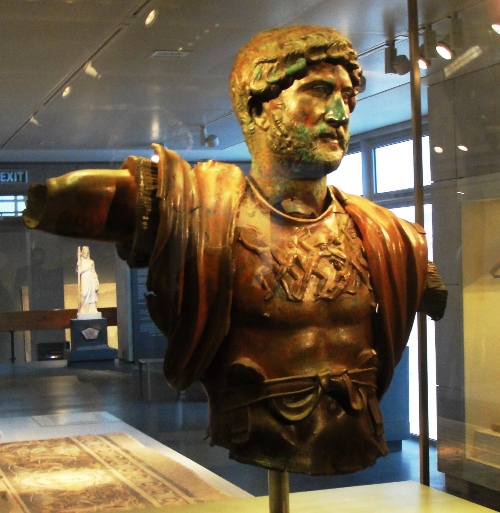 The article covers the time period after the Bar-Kokhba Revolt when the emperor Hadrian banished Jews from the city of Jerusalem.
This partial statue of Hadrian is in the Israel Museum.
In the article there are some great pictures of inscriptions and other items showing Jewish life in the city up to the time of Byzantine Jerusalem.
The article is very interesting, and I also learned about a failed attempt to rebuild the Temple.
 There are still remnants in Jerusalem from the time of Hadrian. Some are mostly hidden like this portion of Hadrian’s Arch. You can read more about this arch in my post: Temple Mount
There is another Hadrian remnant in my post: Boxing Day
As I started to page through BAR, I saw an info box titled: BAR Scholarship Winners Head to the Trenches
The box contains a list of volunteers who were awarded scholarships to go on an archaeological dig this year.
 One of the scholarship winners was my friend Rebekah Dutton. Here she is with her husband Trent at the south end of the Temple Mount in Jerusalem.
They were on the tour with me when I went to Israel, and are now both going to school majoring in Archaeology. This year they were at the Ashkelon dig.
 Another article that caught my eye was: 2,000 Ancient Aramaic Business Scribbles (including the delivery of 30 mice) by Ada Yardeni
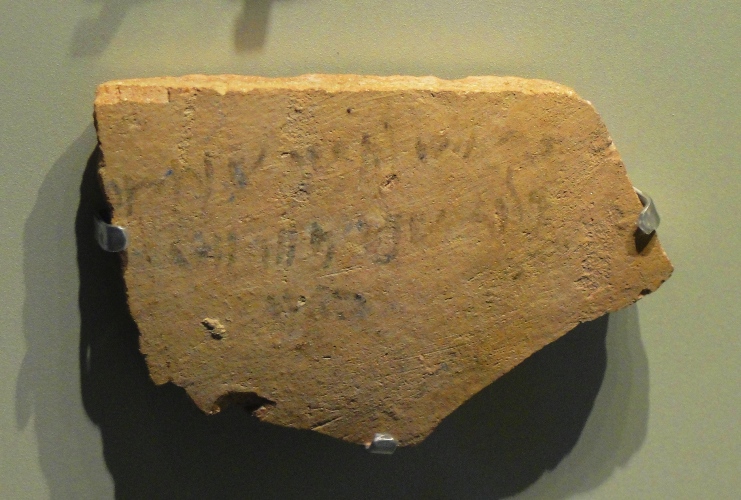
I remembered seeing ostraca in the Israel Museum, so am curious to learn more about them.
Ostraca are pieces of pottery that have writing on them. The article talks about how they were used to record business transactions in Aramaic.
I do not have a translation of the ostracon above, but I am pretty sure that it is of this type.
 This ostracon records a transaction for barley.
In this case, I took a picture of the sign. One thing that I don’t always remember to do when I take pictures in a museum.
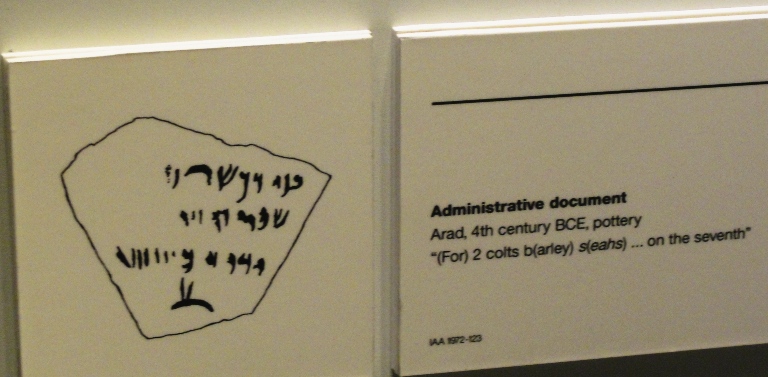 The ostracon comes from Tel Arad and is from the 4th century BC.
Of course there are other articles, but the two above are the ones that caught my eye as I scanned through the magazine.
I will be taking this issue with me on my upcoming trip. I will have plenty of time to read on the long flight.
Of course, I am already looking forward to the next issue as it will probably have details of recent discoveries on digs from this year.
Which article would you read first?
Steven
 Braman's Wanderings
Pingback: In the BAR VII | Braman's Wanderings
Pingback: In the BAR VIII | Braman's Wanderings