
George Stanley McGovern passed away on Sunday at the age of 90. Senator McGovern is probably best remembered for his participation in the 1972 presidential election.
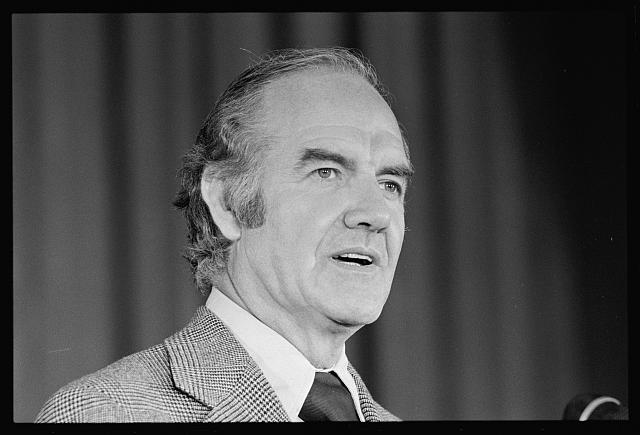
George Stanley McGovern – Photo from Library of Congress
McGovern was the Democratic candidate for the 1972 presidential election. His path to the nomination took several twists and turns. The early favorite for winning the nomination was Ed Muskie who had been the 1968 vice presidential candidate. Muskie faded from the race as it became a three way race between McGovern, Alabama Governor George Wallace and Senator Hubert Humphrey. George Wallace had run for president in the 1968 election on the American Independent Party and had won five states. However, in May George Wallace was shot in an assassination attempt that effectively ended his campaign. McGovern was ultimately chosen as the Democratic candidate at the convention. The convention then chose Thomas Eagleton as the vice presidential candidate and it was downhill from there. Eagleton came under scrutiny for having undergone electroshock therapy for depression and was soon asked to resign. After many prominent democrats turned down the nomination, it finally went to Sargent Shriver.
In the general election, McGovern ran against Richard Nixon and third party candidate John G. Schmitz of the American Independent Party. The American Independent Party was hoping to build upon their success in the 1968 election, but fell well short. Richard Nixon won the election in a huge landslide. McGovern only carried the state of Massachusetts and the District of Columbia.
As we look back at this election, we see that Nixon and his running mate Spiro Agnew both resigned their office and the presidency was filled by Gerald Ford. It is interesting that events that led to Nixon’s resignation happened during the 1972 campaign against McGovern.
McGovern is best know for his landslide loss in the 1972 election, but we should not overlook his many accomplishments as Senator from South Dakota and his work with different world hunger programs for which he won a Presidential Medal of Freedom. We should also remember his service with the Air Force during WWII for which he was awarded the Distinguished Flying Cross and the Air Medal with three oak leaf clusters.
Steven
 Braman's Wanderings
Reblogged this on Janet Bingley.
Very interesting Steven, I didn’t know much about those times but of course recognize all the usual suspects. I was only 11 at the time, but my dad watched the national news every night of his life so I guess I paid more attention than I thought.
How soon we forget. Thanks for jogging my mmemory. For some reason your artticle reminds me of Isaiah 28:10
“Do this, do that, a rule for this, a rule for that;
a little here, a little there.” 🙂